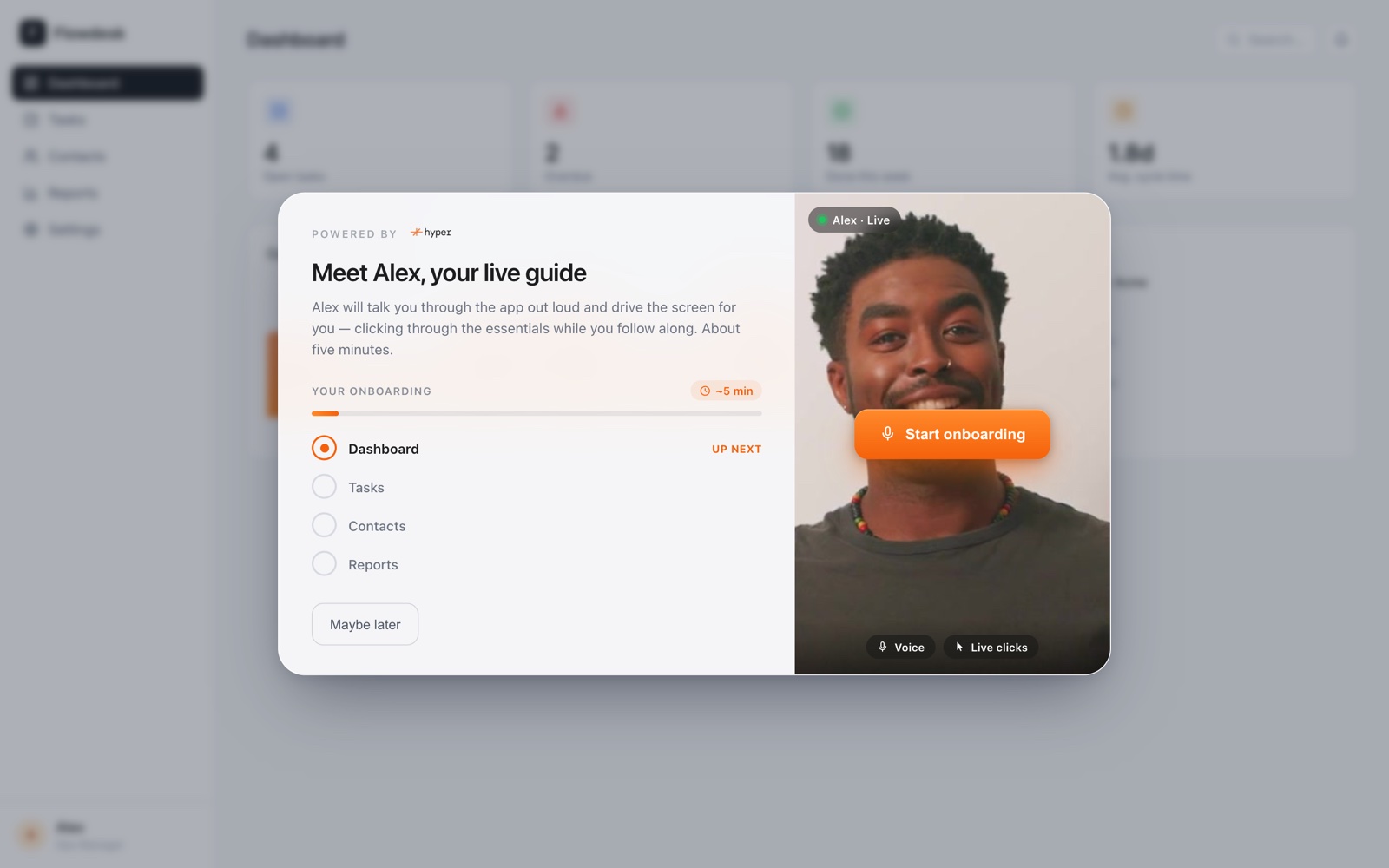
An AI onboarding agent is an AI-powered guide that lives inside your product, detects each new user's first login, and walks them through a personalized onboarding session in the real interface — co-driving their browser, clicking alongside them, answering questions, and leading them to their aha moment from minute one. No tooltips, no pre-recorded videos, no "book an onboarding call for next Thursday." The user signs up, and the onboarding simply happens.
This article covers why onboarding is where SaaS churn is actually decided, why the traditional options — tooltip tours, docs, and CSM-led calls — all fail at scale, how Hyper's new Onboarding Agent works, and the part most teams underestimate: the product intelligence an AI onboarding agent generates from every single session.
If you run a Customer Success team, this is aimed at your biggest structural problem. If you're a CEO, it's aimed at your retention curve.
Churn isn't decided at renewal. It's decided in week one.
The uncomfortable truth about SaaS retention is that most of it is settled long before anyone talks about renewals. Roughly 75% of users abandon a product within their first week if they don't reach value quickly, according to aggregated SaaS onboarding research. And poor onboarding experiences during the first 90 days drive as much as 70% of early customer churn.
The activation numbers tell the same story. Median B2B SaaS activation sits around 37.5%, with many companies stuck at 15–20% — meaning that for every ten signups a typical SaaS company pays to acquire, six to eight never experience the product working for them even once. They churn before they were ever really customers.
Here's the detail that should reframe how you think about this: activation isn't low because guided onboarding doesn't work. It's low because almost nobody gets it. Benchmarks show that sales-led products with dedicated human onboarding activate 60–75% of users, versus 25–40% for self-serve products relying on tours and docs (ProductQuant). Guided, human-quality onboarding roughly doubles activation. The problem was never whether it works — it's that until now, it couldn't scale.
The impossible math of 1:1 onboarding
Every Customer Success leader knows this equation by heart. A high-touch CSM can properly onboard and manage somewhere between 5 and 15 accounts — call it 22 at the aggressive end. A healthy self-serve or PLG motion brings in hundreds or thousands of new users a month.
So CS teams do the only rational thing: they triage. Enterprise accounts get the white-glove onboarding call. Everyone else gets a tooltip tour, a checklist, a knowledge-base link, and a "getting started" email sequence. The users who happened to sign up on a Saturday night, or in a language your team doesn't speak, get even less.
The result is a two-tier onboarding system where the tier that gets ignored — the long tail of self-serve signups — is precisely where most of your churn comes from. It's the same capacity bottleneck we've written about on the sales side in Scale Your Sales Demos Without Hiring: humans don't scale, and the compromise solutions (static content) don't convert.
For a CEO, this reads as a CAC problem. You paid full acquisition cost for every one of those signups. Every user who churns because nobody showed them the product is marketing budget converted directly into nothing.
What is an AI onboarding agent?
An AI onboarding agent closes the gap between the onboarding that works (guided, personal, live) and the onboarding that scales (automated). It's a new category of product — distinct from tour software, chatbots, and session-recording tools — defined by four properties:
- It lives inside your product. The agent is embedded in your app. It detects new users automatically and appears only to them, on their first login. Existing users never see it.
- It operates in the user's real session. This is the defining capability: the agent co-manages the browser, performing real clicks in the same live, authenticated session as the user. The onboarding happens in the actual product, with the user's actual account — not a sandbox, a video, or an overlay pointing at buttons.
- It's conversational and adaptive. The user can ask questions at any point — "wait, what does this setting do?" — and the agent answers and adjusts the path. A tooltip tour follows one script for everyone; an agent follows the user.
- It's goal-directed. The agent isn't showing features for the sake of it. It's driving toward one destination: the aha moment — the point where the user has experienced your product's core value with their own data, in their own account.
The nearest analogy is having your best onboarding specialist sit next to every single new user during their first session — except this specialist speaks every language, works at 3 a.m., and can be in a thousand places at once.
Not to be confused with employee onboarding
One disambiguation before going further, because search results mix the two. Most pages ranking for "AI onboarding agent" today are about HR: new-hire paperwork, IT provisioning, day-one checklists for employees. That is a different category solving a different problem. This article is about onboarding the users of your software product: turning signups into activated customers. If you were looking for help onboarding employees, this is not that.
How Hyper's Onboarding Agent works
We built the Hyper Onboarding Agent because we kept seeing the same pattern in our demo work: the companies best at converting prospects with AI-led product demos were losing those same users days later to onboarding that never happened. The agent applies the same principle — AI that guides people through the real product — to the moment that decides retention.
The flow, from your user's perspective:
- A new user signs up for your product. The agent detects the first login automatically — no CS handoff, no scheduling, no trigger configuration for each account.
- The agent introduces itself and offers to guide them. Only new users see it, only on their first session.
- It co-drives the browser through setup. The agent clicks through the product with the user in their live session — creating the first project, connecting the integration, importing the data — while explaining what it's doing and why. Everything it sets up is real progress the user keeps.
- It resolves doubts as they appear. Questions get answered in the moment they're asked, in the user's own language, instead of being deflected to a help center.
- It lands the user at the aha moment. The session ends with the user having experienced the product's core value — activated, not just toured.
Because the agent is software, the economics look nothing like human onboarding: it runs at any hour, in any language, handles thousands of concurrent sessions, and costs a fraction of a single CSM hire. The 60–75% activation rates that used to be exclusive to sales-led, high-touch products become available to every signup you get — including the Saturday-night ones.
See the Onboarding Agent inside a real product
Watch it detect a new user, take the browser, and guide them to the aha moment — live, in your own product.
Book a demo →AI onboarding agent vs. product tours vs. CSM-led onboarding
Most teams today combine three approaches: tooltip tours for everyone, documentation for the motivated, and human onboarding for the accounts that justify it. Here's how an AI onboarding agent compares:
| Tooltip tours | Docs & videos | CSM-led onboarding | AI Onboarding Agent | |
|---|---|---|---|---|
| Coverage | All users | Users who look for it | Top accounts only | All users |
| Personalized path | No — one script | No | Yes | Yes — adapts per user |
| Answers questions | No | Passively | Yes | Yes, in real time |
| Works in real session | Overlay only | No | Screen share | Yes — real clicks, user's account |
| Timing | First login | Whenever | Days later, scheduled | First login, instantly |
| Languages | What you localize | What you translate | What your team speaks | Any language |
| Data captured | Completion rate | Page views | CSM notes | Full session report + aggregates |
| Cost per user | Low | Low | Very high | Low |
The timing row deserves emphasis. Users who hit their aha moment in the first session are 2–3× more likely to become long-term active users (Artisan Strategies), yet median time-to-value across SaaS is over a day — and CSM-led onboarding usually happens days after signup, if the user shows up at all. By the time the scheduled onboarding call arrives, the churn decision has often already been made. An agent that onboards at first login attacks the problem at the only moment that fully counts.
Every onboarding becomes product intelligence
Here's the part that turns the Onboarding Agent from a CS tool into a company-wide asset: every session generates structured data about how real users actually experience your product.
Hyper produces two levels of reporting:
- Per-session reports. For each new user: the path they took, where they hesitated, what they asked, where they got stuck, whether they reached activation, and where they dropped off if they didn't.
- Aggregate reports. Across all your new users: the ranked friction points of your onboarding, the questions asked most often, the steps where drop-off concentrates, and how activation is trending.
Think about what this replaces. Today, product teams reconstruct onboarding friction from session-replay heatmaps, funnel charts, and the occasional user interview — all indirect signals that tell you where users struggled but rarely why. An onboarding agent is having a conversation with every new user at the exact moment of friction. When 40% of them ask the same question at the same step, that's not an analytics hypothesis — it's your users telling you, verbatim, what's confusing. Your roadmap prioritization just got an evidence source that didn't exist before.
This is the same thesis behind demo-led growth: AI agents that interact with users don't just do the work — they capture ground truth about intent and friction that static tools structurally cannot see.
What this means for Customer Success teams
The obvious question from CS leaders: does this replace my team? The honest answer is that it replaces the part of the job that was never a good use of your team — repeating the same walkthrough for the fifteenth time this week — and upgrades the rest:
- Coverage stops being a triage decision. Every user gets guided onboarding, not just the top 10% of accounts. The long tail — where most churn lives — finally gets covered.
- CSMs move up the value chain. With first-run onboarding handled, human time shifts to strategic accounts, expansion conversations, and the escalations where a person genuinely matters.
- Onboarding stops being a calendar problem. No more "first available slot is Thursday" for a user who signed up Monday morning — the window where most abandonment happens simply closes.
- You get instrumentation you never had. Session and aggregate reports give CS leaders hard data for the conversations they've been having on intuition: what's actually blocking activation, and whether it's improving.
For CEOs, the framing is simpler. Onboarding is the highest-leverage point in the retention curve, it's currently your least consistent process, and it just became automatable at near-zero marginal cost — with a data exhaust that feeds product strategy. That combination is rare.
The bottom line
SaaS spent the last decade perfecting how to acquire users and the last five years perfecting AI for sales conversations. Onboarding — the step that decides whether any of that investment survives week one — stayed manual for the few and static for the many.
AI onboarding agents end that trade-off. Guided, 1:1, in-product onboarding for every user, in every language, at any hour, with every session feeding back into your product decisions. The teams that adopt this first won't just retain more users — they'll understand their product's first-run experience better than anyone in their market.
Frequently asked questions
Give every new user the onboarding your best accounts get
Hyper's Onboarding Agent guides each new user to the aha moment inside your real product — any language, any hour, every signup.
Book a live demo →