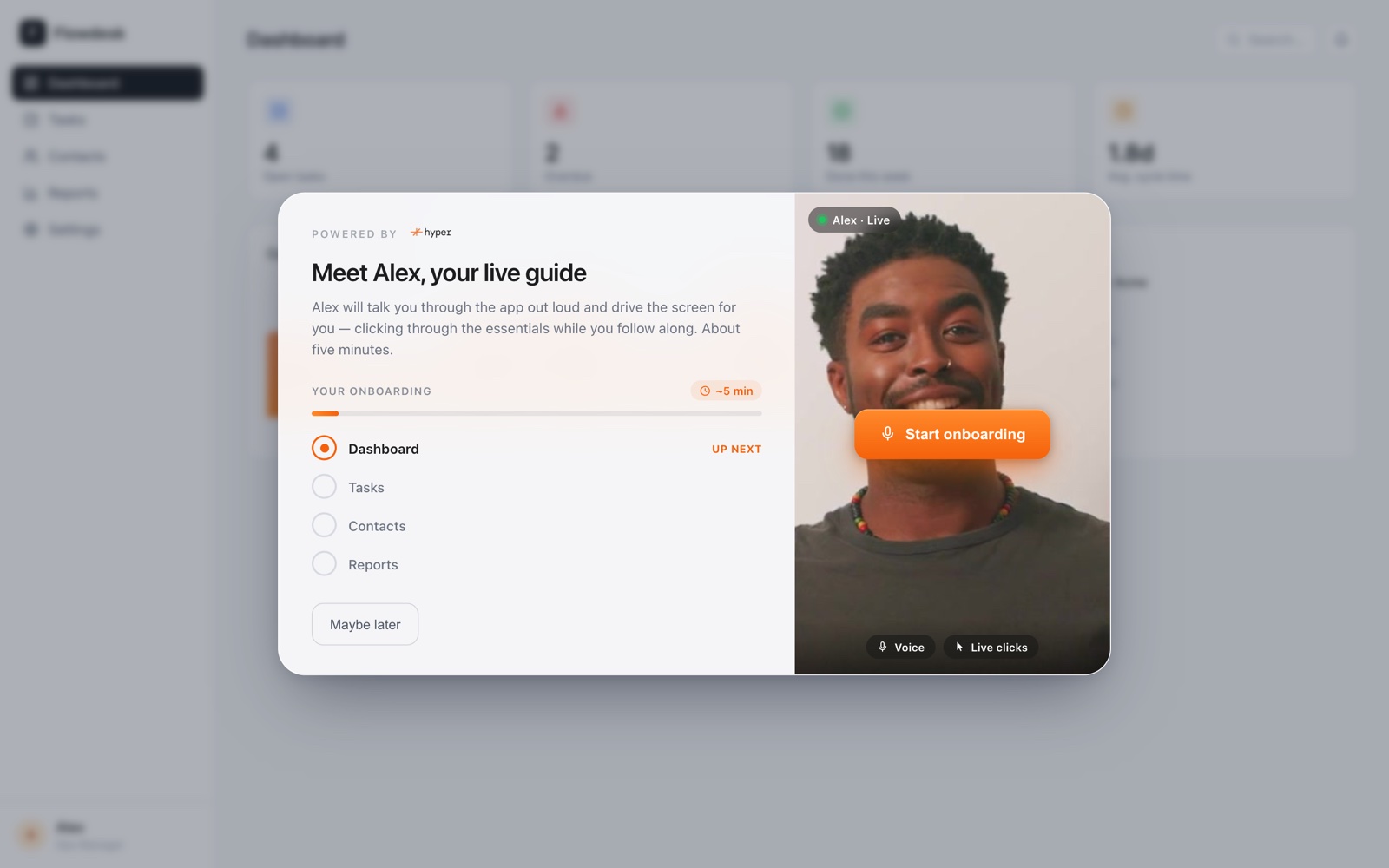
Nobody signs up for your product to get good at using your product. They sign up to solve a problem, and every minute spent hunting for a button is a minute they didn't want to spend. That mismatch is the whole subject of the product tours vs AI onboarding question: most onboarding stacks are still built to teach the interface, as if familiarity with your UI were the goal instead of the user's actual task.
This isn't a two-option comparison, tours on one side and AI on the other. Onboarding has moved through three distinct generations, and each one measures success differently. The mistake most teams make is treating the newest generation as a nicer version of the last one. An agent that acts inside a user's real session, in real time, is a different category of tool, not an upgrade to the tour you already have.
Product Tours vs AI Onboarding: Three Generations, Not Three Options
Line up what's actually shipped in this space over the last decade and a pattern falls out. Each generation changed what the user experiences, and, just as importantly, what a team can actually measure about whether onboarding worked:
- Generation 1, static tours. Tooltips, hotspots, and checklists overlaid on the interface, one fixed script shown to every user regardless of who they are.
- Generation 2, segmented flows. The same kind of pre-written content, but branched ahead of time by role, plan, or company size, so different users see different scripts.
- Generation 3, live agents. Software that performs the onboarding task alongside the user, inside their real, authenticated session, and adapts based on what that specific person does or asks.
The first two generations are variations on the same idea: pre-written content the user has to notice, choose to follow, and self-navigate. The third generation changes who's doing the work.
Generation 1: Static Product Tours
This is the onboarding most SaaS products still ship today: a welcome tooltip pointing at the sidebar, a checklist counting down "3 of 7 steps complete," a hotspot pulsing over a button nobody asked about. It's cheap to build, easy to A/B test, and it was a genuine improvement over shipping a product with no onboarding at all.
The problem is that it's fundamentally passive. The content is written once, for an imaginary average user, and shown identically to a first-time freelancer and a returning enterprise admin alike. Intercom's own data from launching Product Tours found customers using them saw 7x more engagement than email, which sounds like validation, until you look at what happens once a tour is actually running: Chameleon's 2025 Benchmark Report, drawn from more than 550 million user actions, found that roughly 70% of users skip traditional, linear product tours entirely.
What Generation 1 measures reflects that passivity: tour completion rate, click-through on individual tooltips, checklist progress. Those numbers describe how many people tolerated the tour, not whether they got anything done. A user can finish every step of a checklist and still never reach the moment where the product actually solves their problem.
Generation 2: Personalized Flows by Segment
The next generation kept the same underlying format, tooltips and checklists, but stopped showing everyone the identical script. Flows branch based on the role someone selected at signup, the plan they're on, or the use case they picked from a dropdown. A sales manager sees a different first-run path than an individual contributor. An enterprise trial sees different steps than a self-serve signup.
This is a real improvement, and it's where most current product tour and digital adoption platforms operate today. Segmenting by cohort means the content is at least relevant to who's looking at it, and teams can measure activation by segment instead of one blended number that hides more than it reveals, something we've written about in more depth in our breakdown of SaaS activation rate benchmarks.
But the branching still happens ahead of time, by whoever built the flow, not in response to what an actual user does. If someone gets stuck on a step the flow-builder didn't anticipate, or has a question the script doesn't cover, the flow has nothing to offer. It's a better script. It's still a script.
Generation 3: An Agent That Executes and Guides, Live
The third generation doesn't show the user where to click. It clicks with them. An AI onboarding agent lives inside the product, detects a new user's first login, and co-drives their actual browser session in real time, highlighting fields, performing steps, and waiting while the user follows along, in their own language, at any hour. We go deeper on how this works in our full breakdown of the AI onboarding agent category.
The distinction that matters isn't voice, or animation, or a friendlier tone. It's that the system can react. When a user asks an unscripted question, an agent can answer it from the product's docs and help center, right there, instead of leaving the user to abandon the flow and go searching. When a user takes an unexpected path, the agent adapts instead of running out of script. That's not possible for content that was finished being written before the user ever signed up.
According to Perspective AI's 2026 analysis of roughly 1,400 organizations, AI-native onboarding shows a 3.2x median lift over tour-based onboarding, rising to 4.8x in the top quartile. That's vendor-reported data with an obvious commercial angle, so the exact multiple is directional rather than a guarantee for every product. But it points the same direction as the underlying activation numbers: median B2B SaaS activation sits at just 37.5% (Userpilot, 62-company study), and Amplitude's 2025 study of 2,600+ companies found that more than 98% of new users churn within two weeks if they never reach a real value milestone. Passive content that depends on the user choosing to engage is a large part of why that gap exists.
What Generation 3 measures is also different in kind, not just in degree. Instead of tour completion, it's whether the user actually reached their first real value moment. Instead of a blended engagement score, it's a structured report, per session and in aggregate, showing exactly where users hesitated, where they dropped off, and what they asked. That's product intelligence a team can act on, not a vanity metric that looks fine right up until the churn number lands.
| Generation | What the user does | What gets measured |
|---|---|---|
| 1. Static tours | Clicks through one fixed script, if they don't skip it | Tour completion, tooltip click-through |
| 2. Segmented flows | Clicks through a script picked in advance for their segment | Cohort activation, flow drop-off point |
| 3. Live agent | Works alongside an agent acting in their real session | Real task completion, aha moment reached, per-session friction |
See a live agent onboard a new user, not a slideshow
Hyper's Onboarding Agent detects every new signup's first session and co-drives them to their first real value moment, in any language, 24/7.
See the Onboarding Agent →Why an Agent Isn't Generation 2.5
It's tempting to file live agents under "an even more personalized flow," one more branch added to the segmentation tree. That undersells what actually changed. Segmentation, no matter how granular, is still a decision made in advance by whoever built the flow. An agent operating inside the live session makes decisions in the moment, based on what one specific user is actually doing, which is a structurally different capability, not a deeper level of the same one.
The stakes are real money, not just a cleaner category diagram. Roughly 70% of churn happens in the first 90 days, and shortening time-to-first-value to under seven days is associated with roughly half the churn of a slower path, patterns that show up consistently across SaaS activation and retention research. We've covered the funnel-level version of this problem in our audit of free trial to paid conversion benchmarks: if users never reach activation, no amount of downstream pricing or paywall optimization recovers them, and passive onboarding content is one of the biggest reasons activation stalls in the first place.
How to Tell Which Generation Your Onboarding Is Actually In
Most teams assume they're further along than they are, because "personalized onboarding" gets used loosely to describe both segmented flows and live agents. A few honest questions settle it:
- If a user asks a question mid-flow, what happens? If the answer is "nothing, they have to go find help elsewhere," you're in Generation 1 or 2, regardless of how well-branched the content is.
- Was today's onboarding content written before today's user signed up? If every word and every branch existed before this specific person logged in, nothing in the session is reacting to them.
- What does your onboarding report actually tell you? "82% completed the tour" is a Generation 1 or 2 metric. "Here's exactly where each new user got stuck this week, and what they asked" is a Generation 3 metric.
- Does it work the same at 3 a.m. in a language your team doesn't speak? Static content technically does. Whether it actually helps that specific user in that moment is a different question.
None of this means ripping out a tooltip for a minor UI change or a release note. It means being honest about which generation is doing the heavy lifting for the moment that actually decides whether a signup becomes a customer: the first session.
We're running a small number of free onboarding pilots with SaaS teams who want to see a live agent handle their own first-run experience, not another slide deck about the category. If that's useful to you, we'd like to talk.
Frequently asked questions
See what Generation 3 looks like in your own product
We're running free onboarding pilots with a handful of SaaS teams. Hyper's Onboarding Agent guides every new signup to the aha moment, live, and reports exactly where they got stuck.
Talk to us about a pilot →