Most teams don't go looking for Pendo alternatives because Pendo is a bad product. They go looking because the sales conversation to buy it, and the annual contract that follows, doesn't match what they actually needed: in-app onboarding for new users, not a full product analytics and session replay platform priced like one. That mismatch is the real reason this search happens, and it shapes which alternative is worth switching to.
This guide compares six real Pendo alternatives on the two things that actually decide a switch: current public pricing and what each one can and can't do. Five are close peers or lighter-weight onboarding tools. The sixth works on a different principle entirely, and we've tried to be upfront about where that distinction matters and where it doesn't.
Why Teams Look for Pendo Alternatives
Pendo's paid plans, Base, Core, and Ultimate, all display "request pricing" instead of a number. Every purchase goes through a sales-led process, and pricing scales with monthly active users (MAU), number of apps, and which add-ons (session replay, feedback, roadmaps) you need. Pendo does offer a free plan for up to 500 MAUs with basic analytics and in-app guides, but anything past that is a custom annual contract.
Based on Vendr's data covering roughly 400 reported deals, typical annual Pendo contracts range from about $15,000 to $142,000+, with a mid-market average around $47,000–$48,500 a year. Entry-level Base deals tend to start near $15,900 annually. For a team that just wants to onboard new users well, not run a full product analytics program, that's a lot of platform, and a lot of procurement process, to buy for one job.
The other reason teams shop around has nothing to do with Pendo specifically: like the rest of this category, its onboarding layer is still built on tooltips, checklists, and guides, pre-written content the user has to notice and choose to follow. Pendo's own analytics are genuinely strong at showing you afterward that adoption is stuck. They don't do the work of fixing it in the moment a specific user is stuck.
Pendo Alternatives at a Glance
| Tool | Entry price | Best for | Format |
|---|---|---|---|
| Pendo | ~$48.5K/yr median (Vendr) | Product analytics + onboarding in one platform | Tooltips + session replay/analytics |
| Userpilot | $299/mo, 2,000 MAU | Self-serve onboarding with lighter built-in analytics | Tooltips, checklists, surveys |
| Appcues | ~$300/mo, 1,000 MAU | Design-polished no-code flows | Tooltips, checklists, NPS |
| Chameleon | ~$279–333/mo, 2,000 MTU | Deep customization, dev-friendly teams | Tooltips, checklists, microsurveys |
| UserGuiding | ~$174/mo | Budget-conscious small teams | Tooltips, checklists, knowledge base |
| Whatfix | ~$25K–100K+/yr | Large, multi-app enterprise rollouts | Full digital adoption platform |
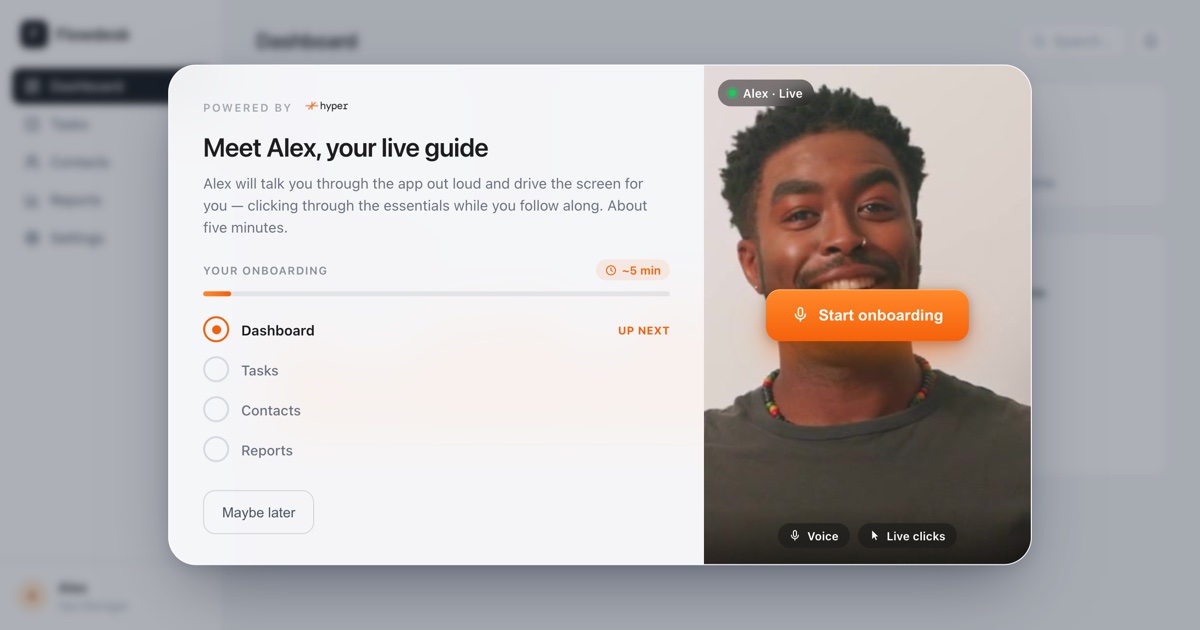
| Hyper Onboarding Agent | Transparent, on request | Getting new users to activation, not just a dashboard | Live agent, co-drives the session |
Pricing above reflects publicly available data as of September 2026; MAU/MTU-based tools reprice as your user count grows, and Pendo's own price is a sales quote, so treat every figure here as a starting point for your own conversation, not a locked number.
1. Userpilot: The Closest Self-Serve Swap
Userpilot is the most direct downgrade path from Pendo for teams that mainly want in-app onboarding with reasonable built-in analytics, without a sales-led contract. It's self-serve: the Starter plan runs $299/month for up to 2,000 MAU and three seats, with a Growth plan around $849/month for up to 100,000 MAU that unlocks checklists, a resource center, and A/B testing, per Userpilot's own published pricing.
Where it's genuinely a better fit than Pendo: teams that want to buy and start today without a sales call, and whose analytics needs stop at feature adoption and basic funnels rather than session replay or a feedback-to-roadmap pipeline. Where it isn't: Userpilot's analytics and feedback tooling are noticeably lighter than Pendo's Ultimate tier, so teams that lean on session replay or unified product-and-onboarding reporting will feel the gap.
2. Appcues: Fast to Launch, Lighter on Analytics
Appcues is a no-code builder for flows, checklists, and NPS surveys, generally regarded as more design-polished out of the box than Pendo's guide builder, with native support for guiding users inside iOS and Android apps. Pricing follows an MAU-based structure: a Start plan around $300/month for roughly 1,000 MAU, a Grow plan from about $879 to $1,500+/month, and Enterprise typically landing between $2,000 and $5,000+/month for 25,000+ MAU, according to pricing data compiled by Vendr and industry pricing guides. Vendr's analysis of 127 real Appcues purchases put the median annual contract at roughly $15,000, well under Pendo's median.
Where it's genuinely a better fit than Pendo: teams that care most about a fast, polished flow builder and solid native mobile onboarding, at a fraction of Pendo's typical contract size. Where it isn't: Appcues doesn't attempt to be a product analytics platform the way Pendo does; if session replay or deep behavioral cohorting is the actual requirement, this isn't a like-for-like swap.
3. Chameleon: More Configurable, Steeper to Learn
Chameleon competes on depth of customization rather than price. It uses Monthly Tracked Users (MTUs) rather than MAUs as its billing metric, worth checking against your own traffic before comparing sticker prices directly. The entry Startup plan runs $279 to $333/month (billed annually) for up to 2,000 MTU, the Growth plan starts around $999/month, and Enterprise is fully custom, per Chameleon's help center and third-party pricing trackers.
Where it's genuinely a better fit than Pendo: teams with developer resources who want granular control over targeting logic and custom CSS on the onboarding layer, without paying for a full analytics suite alongside it. Where it isn't: smaller teams without engineering support often find Chameleon slower to get running than a more guided setup.
4. UserGuiding: The Budget Pick
UserGuiding is the cheapest full-featured onboarding option on this list, and the widest gap from Pendo's pricing. Its Starter plan runs around $174/month billed annually, with a Growth plan around $349/month and custom Enterprise pricing above that. It also offers a free Support Essentials tier limited to a knowledge base.
Where it's genuinely a better fit than Pendo: small teams or early-stage startups where budget is the binding constraint and the core need is straightforward tours, checklists, and in-app messages, not analytics depth. Where it isn't: UserGuiding's reporting is noticeably lighter than Pendo's, so teams that actually use Pendo's cohort analysis or session replay day to day will lose real functionality, not just polish.
5. Whatfix: When Pendo Itself Isn't Enough
Whatfix sits in the opposite direction from the other four: it's a full digital adoption platform (DAP), a tier above even Pendo's Ultimate plan, built for large organizations rolling out guidance across many internal and customer-facing applications at once. Whatfix doesn't publish pricing, but industry data puts average annual spend around $31,950, with entry-level plans reportedly starting above $24,000/year and large multi-app enterprise deployments exceeding $100,000/year, overlapping and often exceeding Pendo's own range.
Where it's genuinely a better fit than Pendo: large enterprises standardizing in-app guidance across many applications, internal tools included, where Pendo's single-product focus becomes a limitation. Where it isn't: if you're evaluating Pendo alternatives to spend less, Whatfix is very often not the answer; it competes with Pendo's ceiling, not its price.
See a live agent onboard a new user, not a dashboard
Hyper's Onboarding Agent detects every new signup's first session and co-drives them to their first real value moment, live, in any language.
See the Onboarding Agent →6. Hyper's Onboarding Agent: A Different Category, Not a Cheaper Dashboard
Every alternative above, including Pendo, is still built on the same underlying mechanic: pre-written tooltips, checklists, and guides that a user has to notice and choose to follow, paired with analytics a team reviews afterward to see whether it worked. Swapping between them changes the price, the polish, or the depth of reporting. It doesn't change that mechanic, or the completion problem that comes with it.
An AI onboarding agent works differently. Instead of showing a user where to click and measuring whether they clicked it, it lives inside your product, detects a new user's first login, and co-drives their actual browser session, performing steps alongside them, answering unscripted questions from your docs and help center as they come up, and adapting to what that specific person does, in their own language, at any hour. We've written more on why this is a distinct generation of onboarding rather than a fancier guide builder in our breakdown of product tours vs. AI onboarding, and on the category itself in what an AI onboarding agent actually is.
According to Perspective AI's 2026 analysis of roughly 1,400 organizations, AI-native onboarding shows a 3.2x median lift over tour-based onboarding, rising to 4.8x in the top quartile. That's vendor-reported data with an obvious commercial angle, so treat the multiple as directional, but it's consistent with the underlying gap: median B2B SaaS activation sits at just 37.5%, according to Userpilot's own 62-company benchmark study, and passive content the user has to self-navigate, however well you can measure it afterward, is a large part of why.
Where it's genuinely a better fit than the other five: when the actual goal is getting more new signups to their first real value moment, not building a better dashboard of who didn't, and when your team wants a structured report on exactly where each user got stuck instead of a usage-analytics chart to interpret. Where it isn't: if deep product analytics, session replay across your whole user base, and a feedback-to-roadmap pipeline are the actual job, that's Pendo's strength, not a live agent's; the two solve different problems and some teams reasonably want both.
On pricing: Hyper's Onboarding Agent pricing is transparent and available on request through a short call, rather than a sales-quoted annual contract, so you can model the real cost against your own MAU before committing.
How to Choose
- If you just need a cheaper, faster-to-launch onboarding tool: UserGuiding for budget, Appcues or Chameleon if design polish or configurability matters more than price.
- If you want self-serve onboarding with reasonable analytics, without Pendo's sales process: Userpilot.
- If you're standardizing guidance across many internal and external apps, and Pendo's own ceiling is the problem: Whatfix, and expect a custom enterprise quote.
- If your real problem is activation, not another analytics dashboard: evaluate a live AI onboarding agent before renewing a Pendo contract sized for a job you're not fully using it for.
None of this means Pendo, or any of the five peers above, is a bad tool. Pendo's analytics depth is real, and for a team that genuinely needs product usage data and onboarding in one platform, it earns its price. What's worth checking, before you renew or switch, is whether the job you actually need done is analytics and guide-building, or getting more new users to activation, because those are different jobs, and the tools built for the first one don't automatically solve the second.
We're running a small number of free onboarding pilots with SaaS teams who want to see a live agent handle their own first-run experience, on their own product, before committing to anything. If that's useful, we'd like to talk.
Frequently asked questions
Try a live agent before renewing another dashboard
We're running free onboarding pilots with a handful of SaaS teams. Hyper's Onboarding Agent guides every new signup to the aha moment, live, and reports exactly where they got stuck.
Talk to us about a pilot →