Every VP of Customer Success eventually runs the same math on a whiteboard: current headcount times accounts per CSM, compared against the logo count the sales team just promised for next quarter. The gap is always bigger than the hiring budget. The instinctive response is to ask for more heads. That's the wrong lever, and pulling it just buys you the same ceiling at a higher price.
The CSM to customer ratio isn't really a staffing metric. It's a proxy for how much of onboarding still requires a specific human to be physically present, walking one account at a time through the same setup steps they walked the last forty accounts through. Fix that dependency and the ratio moves on its own. Don't fix it, and every new hire just extends the same ceiling one CSM's worth further down the road.
What the CSM to Customer Ratio Actually Measures
On paper, the ratio is simple: accounts divided by CSM headcount. In practice, it's a downstream signal of a decision made earlier, how much of onboarding and ongoing support depends on manual, one-to-one human time.
Most B2B SaaS companies bucket accounts into service tiers by revenue, and the ratio changes sharply by tier:
- Below roughly $2,000 MRR: tech-touch, no dedicated CSM at all.
- $2,000-5,000 MRR: a pooled CSM, typically covering 50-100 accounts.
- $5,000-10,000 MRR: a dedicated CSM, typically covering 20-30 accounts.
- $10,000+ MRR: a CSM paired with a solutions engineer.
A mid-touch CSM, the tier most growth-stage B2B SaaS companies staff their core book around, typically covers 40-50 accounts. Push the model toward low-touch or tech-touch, where the product carries more of the onboarding load instead of a person, and coverage climbs past 140 accounts per CSM. The spread between 40 and 140 isn't a difference in CSM talent. It's a difference in how much of the work in front of them still requires a human hand on the keyboard.
The Cost Side of the Ratio
A fully loaded CSM, salary, benefits, tools, and management overhead, runs $90,000-130,000 a year. That's a fixed cost regardless of what the CSM spends their week doing. Whether they're running a strategic quarterly business review with your best account or repeating the exact same "click here, now click here" walkthrough for the fortieth new signup this month, the loaded cost is identical.
Put those two numbers next to each other and the throughput ceiling becomes a hard number, not a vibe. A mid-touch CSM at $110,000 loaded cost covering 45 accounts is spending roughly $2,444 of loaded cost per account per year, and a meaningful share of that CSM's calendar in the first weeks of any given account's life is still first-run onboarding, not the strategic account work the role was built for.
Why the Ceiling Gets Worse as Accounts Get Bigger
The ratio doesn't just compress under volume, it compresses under complexity. Time-to-value climbs sharply with account size: implementations at under $5,000 ARR reach first value in a median of 11 minutes, but the $5,000-25,000 ARR band takes a median of 2.4 days, the $25,000-100,000 band takes 9 days, and accounts above $100,000 ARR take a median of 23 days to reach first value. Every one of those days is CSM calendar time spent on one account, which is exactly the inventory a fixed 40-50 account ratio can't absorb once a book skews toward bigger, more complex customers.
This is also where the cost of getting onboarding wrong compounds fastest. Roughly 70% of SaaS churn happens in the first 90 days of a customer relationship, and a slow, CSM-dependent first-run experience is exactly the kind of friction that produces it. A $100,000 ARR account that churns in month two because its 23-day implementation stalled halfway through isn't just a lost renewal, it's $1,200 of CAC and a chunk of a $90-130k CSM's calendar spent for nothing.
Why Hiring Doesn't Raise the Ceiling
Here's the part that gets missed on the whiteboard. If the reason a CSM can only carry 40-50 accounts is that a meaningful slice of their week is spent manually walking new users through the same first-session steps, hiring a second CSM at $90-130k doesn't change that ratio. It just buys you a second person covering another 40-50 accounts, doing the same repetitive walkthroughs, at the same cost per account. You've added capacity, not throughput. The ceiling is still 40-50 accounts per head, you've just paid to have two ceilings instead of one.
This is the same throughput problem that shows up on the sales side of the business when a team tries to scale pipeline by hiring more reps to run the same manual demos, one at a time, on a fixed calendar. Adding headcount against a manually-bottlenecked process scales cost linearly with revenue. It never breaks the ceiling, because the ceiling was never a headcount problem to begin with.
It also doesn't scale evenly. A CSM covering 45 accounts at the mid-touch tier who picks up five new $50,000 ARR accounts in a quarter, each with a multi-day implementation, doesn't just add five accounts to their book. They lose disproportionate calendar time to those five relative to the other forty, because time-to-value rises with account size while headcount doesn't. The ratio on the org chart says 45 accounts per CSM. The actual capacity being consumed looks nothing like an even split.
The CAC math makes the stakes clear. Median B2B SaaS customer acquisition cost sits around $1,200 per customer. Every account that churns because onboarding was slow, generic, or dependent on a CSM's calendar availability is a $1,200 acquisition cost with nothing behind it, on top of the $90-130k a year you're paying the person who was supposed to prevent that.
| Service tier | Typical accounts per CSM | What's driving the ratio |
|---|---|---|
| Tech-touch (<$2k MRR) | No dedicated CSM | Product and automation carry onboarding entirely |
| Pooled ($2-5k MRR) | 50-100 accounts | Shared coverage, limited 1:1 time per account |
| Dedicated ($5-10k MRR) | 20-30 accounts | Manual, hands-on onboarding and support |
| CSM + solutions engineer ($10k+ MRR) | Fewer, higher-touch | Custom implementation, technical hand-holding |
A Worked Example: The Cost of Standing Still
Take a CS team of six mid-touch CSMs, each carrying 45 accounts, for 270 accounts total, at an average loaded cost of $110,000 per CSM: $660,000 a year in CS headcount. Sales projects 90 new logos over the next two quarters. At the same 45-account ratio, that's two more CSMs, $220,000 a year, to hold the ratio steady.
Now run the same 90 new logos through the "why hiring doesn't raise the ceiling" lens. If a third of each existing CSM's week is still spent on repeatable first-session onboarding, roughly the same tasks for account five as for account forty five, then two new hires at $220,000 buy two more people doing that same repeatable third of the job, not two people who've been freed up for account strategy. The team grows from 270 to 360 accounts. The per-account cost stays essentially flat. Nothing about the underlying throughput problem moved, it just got more expensive to keep pace with.
Compare that to removing the repeatable third of the job instead of hiring against it. If an agent absorbs the first-session walkthroughs and the same-question first-week support, the same six CSMs can absorb a meaningfully larger share of those 90 new logos without the two-hire, $220,000 bill, because the part of their week that didn't scale with headcount stopped being the bottleneck. The ratio on the org chart doesn't have to move for the team's real capacity to.
What Actually Breaks the Ceiling
Raising the ratio without burning out your CSM team means removing the part of the job that doesn't need a specific human present, without removing the part that does. Those are different tasks, and most CS organizations bundle them together by default because that's how onboarding has always worked.
Judgment work, reading a strategic account's risk signals, negotiating an expansion, handling an escalation, genuinely needs a person. Presence work, walking a new user through initial setup, answering the same first-week questions for the twentieth time, confirming someone actually reached their first value moment, doesn't need a specific human doing it live. It needs to happen consistently, in the moment the new user is actually logged in and confused, which is frequently outside a CSM's calendar entirely.
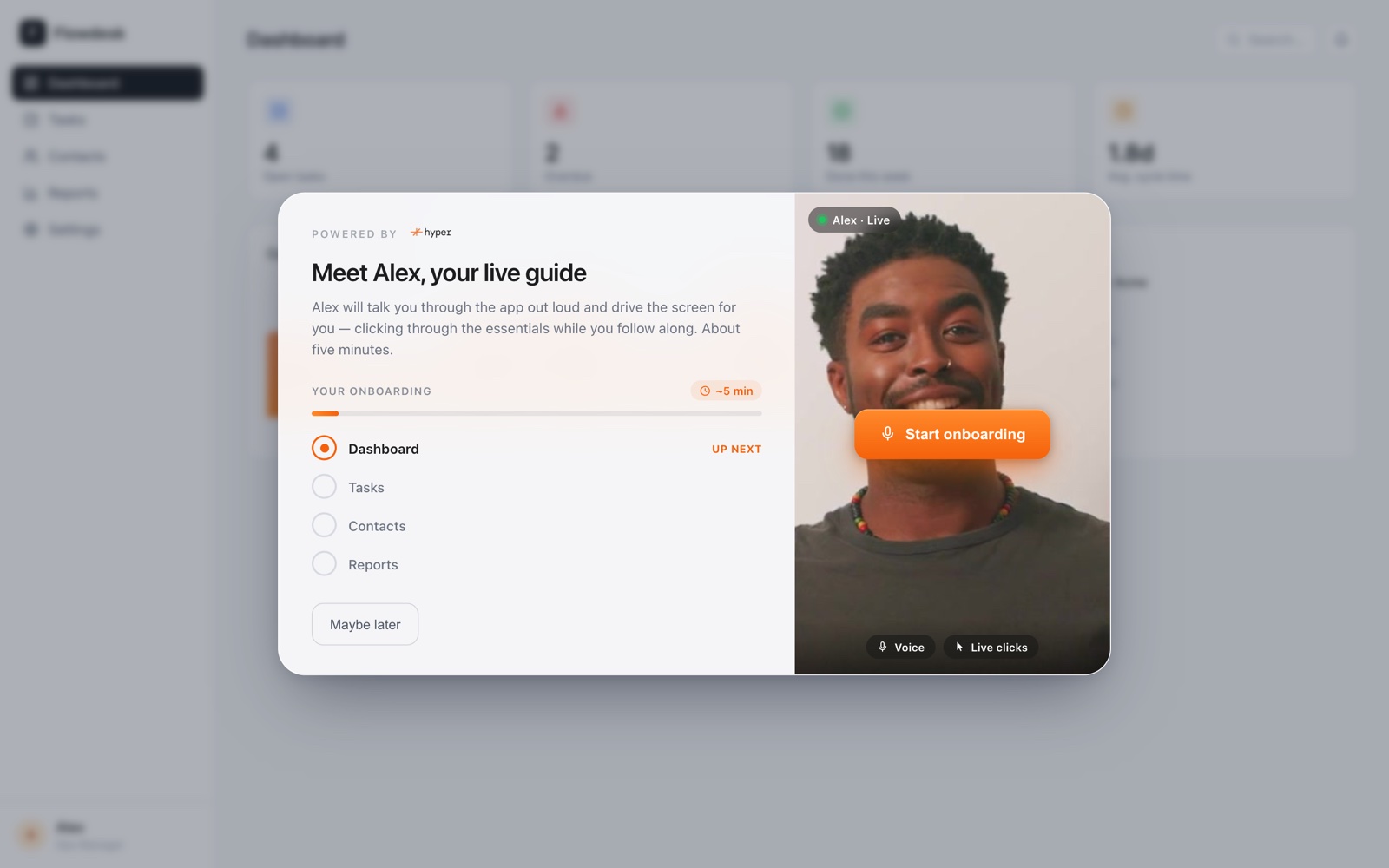
An AI agent that lives inside the product and co-drives that first session, rather than sending the new user to a scheduled onboarding call days later, absorbs the presence work without touching the judgment work. The CSM's week stops being dominated by repeating the same walkthrough and starts being available for the accounts that actually need a strategic relationship. That's a different curve than hiring: capacity scales with signups instead of scaling with headcount, because the co-driving isn't rationed by one person's calendar.
See what stops eating your CSM team's week
Hyper's Onboarding Agent co-drives each new user's first session inside your product, so your CSMs stop repeating the same walkthrough on every new logo.
Book a demo →How to Calculate Your Own Ceiling
Before deciding whether the answer is another hire or a different onboarding model, run the numbers your own team already has:
- Current capacity. CSM headcount times average accounts carried per CSM at your service tier.
- Projected demand. New logos expected over the next two quarters, from the sales team's own pipeline forecast.
- The gap. If projected demand exceeds current capacity, work out how many CSMs you'd need to hire, at $90-130k loaded each, to close it by headcount alone.
- The honest question. Of a CSM's current week, how much is spent on repeatable, first-session onboarding tasks versus account-specific judgment calls? If it's a third or more, headcount is buying you more of the repeatable work, not more strategic coverage.
Most teams that run this exercise find the gap isn't a hiring problem at all. It's a ratio that was set by how much of onboarding depends on a human calendar, and that number is the one actually worth changing. This is the same underlying question we've mapped out for the free-trial side of the business in our audit of free trial to paid conversion benchmarks: whatever the segment, low-ticket self-serve or high-ticket CSM-led, the accounts that never reach real value are the ones burning acquisition cost and headcount capacity for nothing.
We're running a small number of free onboarding pilots with B2B teams carrying this exact ratio problem on the high-touch side of their book. If your CSM team's week is dominated by repeating the same first session over and over, we'd like to show you what that week looks like once an agent is carrying the presence work.
Frequently asked questions
Stop staffing your onboarding ceiling
See how Hyper's Onboarding Agent co-drives every new user's first session, so your CSM team's headcount scales with strategic accounts, not with repeat walkthroughs.
Book a demo →