A new signup logs in, looks around for a few minutes, and leaves. Three weeks later your dashboard shows them as churned, but the real failure happened in those first few minutes: they never reached the moment your product actually delivers on its promise. That gap, between signup and the first real payoff, is time to value, and for most SaaS teams it is a far better predictor of churn than any onboarding checklist completion rate. Reduce time to value in SaaS and you fix the leak before it ever shows up as a churn number.
This is a practical playbook, not a definitions post. It covers what time to value actually measures, the 2026 benchmarks to judge your own number against by deal size, and a 4-step framework to shorten it, for both high-volume self-serve trials and CSM-led enterprise onboarding.
What Time to Value Actually Means (And Why One Number Doesn't Fit Everyone)
Time to value is the median time between signup and the moment a user experiences the specific outcome they signed up for, not the moment they finish an onboarding checklist. Those two things get confused constantly, and the confusion is expensive: a user can tick every box in your product tour and still never reach a value event, while another user skips the tour entirely and gets there in minutes because the thing they needed was obvious.
The benchmark also depends entirely on deal size. According to Perspective AI's 2026 data, median time to value varies by nearly two orders of magnitude across account bands:
| Account size (ARR) | Median time to value |
|---|---|
| Under $5,000 | 11 minutes |
| $5,000 - $25,000 | 2.4 days |
| $25,000 - $100,000 | 9 days |
| $100,000+ | 23 days |
Source: Perspective AI, 2026.
Complexity sets a second bar that works alongside deal size: time-to-activate typically runs 1-3 days for simple, self-serve products, around 7 days for medium-complexity products, and 14-30 days for genuinely complex, multi-stakeholder ones. If your product is complex and enterprise-priced but you're benchmarking against the 11-minute self-serve number, you're measuring yourself against the wrong account entirely. We cover the related, but distinct, question of what percentage of signups ever reach that value event at all in our diagnostic guide to low activation rate in SaaS.
Why a Slow Time to Value Is a Churn Problem, Not Just a Metrics Problem
Time to value isn't an abstract efficiency metric. It maps directly onto when users decide to leave, and the window to influence that decision is shorter than most teams assume.
Roughly 70% of SaaS churn happens in the first 90 days, and reaching first value in under 7 days is associated with roughly half the churn of a slower path. The mechanics line up: most B2B trial conversions happen right around day 7, when the trial is about to expire, and after day 14 conversion rates fall to around 1%. If a user hasn't reached a value event by then, the decision is effectively made.
That 90% figure is the part most teams underweight. A slow time to value doesn't fail gradually, it fails almost immediately: most of the damage is done in the first 72 hours, long before anyone on a CS team would normally flag an account as at risk. We walk through where in the signup-to-value funnel users actually get stuck in Why Users Don't Convert After a Free Trial.
The Real Cost of a Slow Time to Value for High-Ticket Onboarding
For high-ticket, CSM-led onboarding, a slow TTV isn't just a churn risk, it's a direct cost problem. A fully loaded CSM runs $90,000-$130,000 a year, and a mid-touch CSM typically covers 40-50 accounts, while tech-touch models stretch to 140+ accounts. Every extra day between signup and a customer's first real value event is a day that account occupies CSM capacity that could be onboarding the next cohort, and median B2B SaaS CAC in 2026 runs around $1,200 per customer, which is money spent to acquire an account that is now sitting idle in a slow onboarding queue instead of compounding toward retention.
We built a full cost-per-customer model around exactly this tradeoff in Customer Onboarding Cost Per Customer: The Model. The short version: every day you shave off time to value is a day of CSM capacity, and CAC payback, you get back. Hyper's plans for the Onboarding Agent start at €149/month (see full details on pricing), which is a different cost structure entirely from scaling CSM headcount linearly with signup volume.
How to Reduce Time to Value in SaaS: A 4-Step Framework
Reducing time to value in SaaS comes down to four moves, in order. Skipping the first two and jumping straight to tooling is the most common way teams waste a quarter on this problem.
Step 1: Define one value event, not a checklist
Pick the single moment that represents the outcome your product promises, the thing a user would point to if asked "what made this worth it." If you can't name one specific event, you can't measure TTV at all, you're measuring checklist completion instead, which is a weaker and sometimes misleading proxy.
Step 2: Measure your actual TTV, segmented by deal size
Pull a recent signup cohort and measure the real median time from signup to that value event, broken out by account size or complexity band, not as one company-wide average. A single blended number hides the fact that your enterprise accounts and your self-serve accounts have completely different, and completely legitimate, TTV windows.
Step 3: Remove the handoffs between signup and first value
Every scheduled call, support ticket, or "someone will reach out" step between signup and the value event adds calendar-bound wait time on top of the actual work required. This is the single biggest lever for high-ticket onboarding specifically, where a new account can sit for days waiting for a CSM slot to open up. We cover this handoff problem in detail in Replace Onboarding Calls With AI: What Actually Changes.
See time to value drop without adding headcount
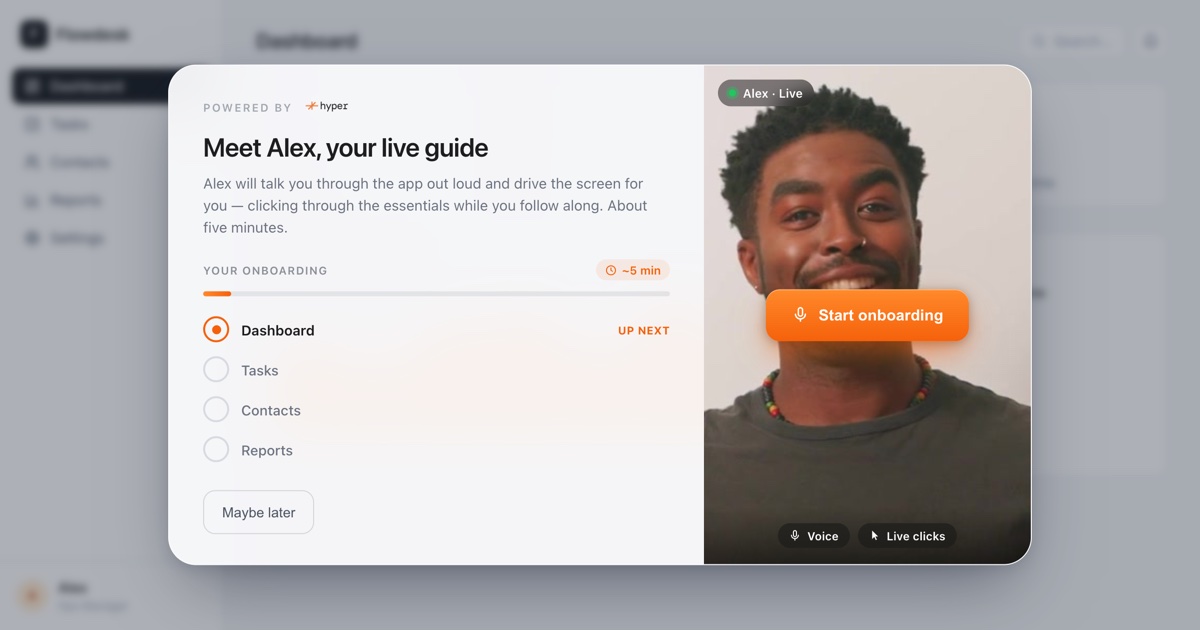
Hyper's Onboarding Agent lives inside your product, detects each new signup's first login, and co-drives their session live toward their real value event.
Talk to us about a pilot →Step 4: Guide users live, don't just instrument them
Analytics dashboards tell you where users dropped off after the fact. They don't catch the stall in the moment and fix it. According to Perspective AI's 2026 survey of roughly 1,400 organizations, AI-native onboarding that guides each signup live shows a median 3.2x lift over tour-based onboarding, rising to 4.8x in the top quartile. That's a vendor figure, not an independent industry consensus, but the underlying logic holds regardless of the exact multiplier: an agent that notices a user is stuck right now and intervenes closes the gap that a tooltip tour, built for the average user rather than this specific one, usually misses.
Low-Ticket vs. High-Ticket: Same Metric, Different Fix
The right lever depends on which segment is losing time. In low-ticket, high-volume self-serve products, the problem is usually that signup volume outpaces the team's ability to guide every user individually, so most never get past the first few minutes unassisted. The relevant benchmark here is the 11-minute median for sub-$5K ARR accounts: if your self-serve TTV is measured in days instead of minutes, the gap isn't a product problem, it's a coverage problem, nobody and nothing is watching that signup in real time.
In high-ticket, CSM-led onboarding, the problem is usually calendar availability, not effort: the actual work to get a customer to their value event might take an hour of guided time, but the account waits days for a CSM slot to open up, and the service thresholds that determine who gets that attention are themselves a constraint. Accounts under roughly $2,000 MRR typically get tech-touch, self-serve treatment; $2,000-$5,000 MRR gets a pooled CSM covering 50-100 accounts; $5,000-$10,000 MRR gets a dedicated CSM with 20-30 accounts; and only $10,000+ MRR accounts get a CSM paired with a solutions engineer. Every account sitting below its segment's natural attention threshold is, by construction, going to have a slower TTV than the benchmark table above suggests it should.
Both problems look identical on a TTV chart and require opposite fixes, which is exactly why segmenting the metric in Step 2 above matters more than optimizing a single blended average.
Common Mistakes That Make Time to Value Worse
- Adding more onboarding steps to "help" new users. Every additional step between signup and the value event adds time, even when each individual step feels small and helpful in isolation.
- Treating every signup the same regardless of deal size. A $2,000 ARR self-serve account and a $150,000 ARR enterprise account need entirely different TTV windows and entirely different onboarding paths, not the same flow at different speeds.
- Measuring TTV only as a single company-wide average. A blended number can look fine while hiding a specific segment that's badly broken.
- Relying on scheduled calls as the only guidance path. Calendar-bound onboarding adds wait time on top of actual work time, every single time.
- Treating a slow TTV as acceptable because the account hasn't churned yet. At a median $1,200 CAC per customer, every account stalled in onboarding is acquisition spend sitting idle rather than compounding toward retention, well before it shows up as a lost logo on a dashboard.
None of these fixes require a product rebuild. They require picking one value event, measuring the real number by segment, and closing the gap between signup and that event with guidance that shows up in the moment a user is stuck, rather than a report that explains the stall after the account is already gone.
Frequently asked questions
Shorten the path from signup to value
Hyper's Onboarding Agent guides every new signup live, inside your product, straight to their first real value event.
Talk to us about a pilot →